
Knowing When To Hold 'Em
Lessons in Volatility from Meta

Back in 2022, I did an intelligent of analysis and valuation of Meta, and smartly bought the stock at around $130/share. It’s now worth ~$330/share, for a gain of ~2.5x in around a year. I’m now in the enviable position of sitting on a huge gain in a high-quality company.
If only that were the case. Before Meta shot up, it fell a lot further, below $90/share. I bought the anti-hype and sold at the bottom, puking out my shares to someone for whom BTFD is a more recognizable acronym than DCF. I am now left with a fancy spreadsheet and regrets. Who’s the idiot?
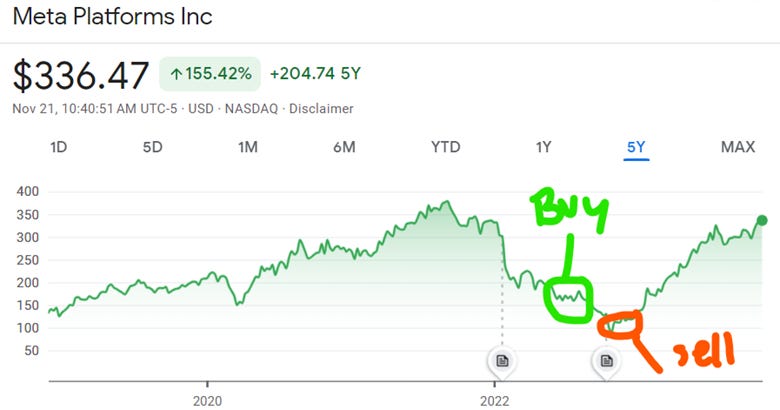
My incredibly poor investing with Meta has taught me a lot though; it may have been tuition well-spent.
The first lesson I learned is behavioural: I can handle volatility better now because I experienced the cost of selling in the hole. My gut didn’t suddenly become steel, I continue to have an average-at-best temperament to stock drawdowns, but now I write out all my theses very simply, convincingly, and often publicly, for my future self to look at and regain conviction. I didn’t suddenly change my psychology, I just adjusted for its weaknesses.
The second lesson is in knowledge. When the price goes down, risk is reduced, and potential returns go up; dislocation is margin of safety, volatility is opportunity. At some point, all the bad news can be priced into a stock, and you can invest with confidence. Risk is counter-intuitive; probabilistic thinking is hard. Not because it’s incomprehensible, but because it feels bad. Thank you to the Metaverse for teaching me my feelings don’t change facts.
The last lesson is in wisdom. Investing is very hard, and buying publicly traded individual companies is probably a stupid thing to do for someone with no knowledge/mentorship in business and investing. If you can’t handle the game, don’t play the game. I’m persistent however, so I’ve decided to lower the difficulty rather than quit (index).
Quality investing seems to be a much easier game. Stocks are easier to own when they grow steadily, have consistently high returns on equity, long-term shareholders, and owner-operators for management. They also tend to deliver strong returns. Constellation Software comes to mind as an example. Ease-of-ownership has become priority for me when analyzing potential investments – no need to make investing harder than it already is.

Zuck could beat me up, but there’s no need because his stock already did. I’m back in the gym the next day though with a few more tricks. We’ll see who the next opponent is and how I fare.